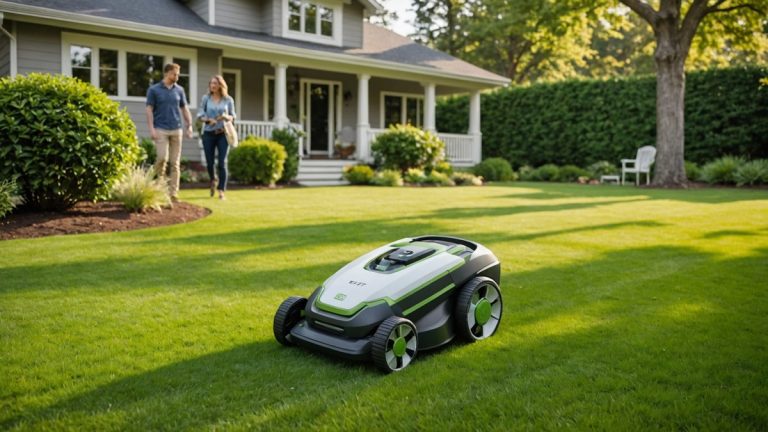
Imagine a robotic mower that ditches the boundary wire, navigates your lawn with AI precision, and handles slopes and obstacles like a pro. That’s the promise of the Eufy E18, a new contender in the autonomous lawn mower space that’s turning heads with its wire-free design and smart features. But is this the future of smart mowing, or just another gadget with growing pains? We put the E18 to the test to see how it stacks up against established players like Husqvarna, Worx, and Gardena.
Wire-Free Freedom: A Game-Changer for Robotic Mowers
One of the biggest selling points of the Eufy E18 is its wire-free operation. Unlike traditional robot lawn mowers that rely on perimeter wires to define their cutting zone, the E18 uses a combination of AI, vision-based navigation, and GPS (in select regions) to map and mow your lawn autonomously. This means no more burying wires, no more awkward workarounds for complex yard layouts, and no more hassle if you decide to redesign your garden.
For homeowners with irregularly shaped lawns or multiple zones, this is a major advantage. Competitors like the Husqvarna Automower 430X and the Worx Landroid Vision still require boundary wires for most setups, making the E18 a standout in the wire-free category. That said, early adopters should note that wire-free autonomous lawn mowers are still evolving, and performance can vary based on yard complexity.
AI-Powered Smart Mowing: How Does It Work?
The Eufy E18 leverages AI and computer vision to navigate and adapt to your lawn in real time. Equipped with multiple cameras and sensors, it can detect obstacles (like toys, pet waste, or garden hoses), avoid them, and even identify areas that need extra attention. This is a step up from traditional bump-and-turn robotic mowers, which often struggle with precision and efficiency.
The mower also supports smart zoning, allowing you to define no-go areas or prioritize specific sections of your lawn via the Eufy app. This is particularly useful for homeowners with flower beds, vegetable gardens, or other areas they want to protect. The app itself is intuitive, offering scheduling, remote control, and performance monitoring—features that rival the best in class, like the Gardena Sileno Life or the Ecovacs Goat G1.
Performance and Specs: What You Need to Know
Under the hood, the Eufy E18 packs some impressive hardware. Here’s a quick rundown of the key specs and features:
- Cutting Width: 9.4 inches (24 cm), suitable for small to medium lawns up to 0.5 acres.
- Battery: 29V lithium-ion battery, providing up to 100 minutes of runtime on a single charge. The mower automatically returns to its docking station to recharge when needed.
- Cutting Height: Adjustable from 0.8 to 2.4 inches (2 to 6 cm), with three settings to accommodate different grass types and preferences.
- Slope Handling: Capable of tackling inclines up to 35%, making it a solid choice for yards with gentle to moderate slopes.
- Obstacle Detection: AI-powered vision system with ultrasonic and bump sensors for comprehensive obstacle avoidance.
- Weather Resistance: IPX5-rated for water resistance, so it can handle light rain (though it’s best to avoid heavy downpours).
- Connectivity: Wi-Fi and Bluetooth enabled for app control and over-the-air updates.
- Noise Level: Operates at around 60 dB, making it quieter than most gas mowers and even some electric models.
In testing, the E18 delivered a clean, even cut on flat and slightly sloped areas. However, like many robot lawn mowers, it struggled with very tall or thick grass, requiring a manual trim before the first few mows. The wire-free navigation worked well in open spaces but occasionally faltered in tight corners or heavily landscaped areas. For comparison, the Worx Landroid Vision handles tight spaces slightly better, thanks to its additional side sensors.
Installation and Setup: Easier Than You Think
Setting up the Eufy E18 is refreshing compared to traditional robotic mowers. Since there’s no boundary wire to bury, the process is streamlined. Here’s how it works:
- Charge the Mower: Fully charge the E18 before the first use to ensure it’s ready to map your lawn.
- Place the Docking Station: Position the charging dock in a flat, open area near a power outlet and within Wi-Fi range.
- Define Your Lawn: Use the Eufy app to guide the mower around the edges of your lawn. The E18 will learn the layout and create a virtual map.
- Set Your Preferences: Configure cutting schedules, height, and any no-go zones via the app.
- Let It Mow: Once setup is complete, the E18 will begin mowing according to your schedule.
For most users, this process takes about 30-60 minutes, depending on lawn size. It’s a far cry from the hours (or days) spent burying boundary wires with traditional models. That said, if your yard has a lot of obstacles or unique features, you may need to fine-tune the virtual boundaries in the app.
What This Means for You
The Eufy E18 is a bold step forward for autonomous lawn mowers, offering wire-free convenience and AI-powered smarts that make it a compelling choice for tech-savvy homeowners. Its ability to navigate without physical boundaries is a game-changer, particularly for those with complex or frequently changing lawn layouts. However, it’s not without limitations—performance in tight or heavily landscaped areas can be inconsistent, and it may struggle with very tall grass or steep slopes.
If you’re looking for a low-maintenance, high-tech solution for a small to medium lawn, the E18 is worth considering. But if your yard is large, hilly, or packed with obstacles, you might want to compare it to alternatives like the Husqvarna Automower 450X (better for large lawns) or the Worx Landroid Vision (better for complex edges). For professional landscapers, the E18 isn’t quite ready to replace commercial-grade models like the Mean Green Mower or the Graze GM1000, but it’s a sign of where the industry is headed.
Priced competitively (around $1,200-$1,500), the E18 sits in the mid-to-high range for robot lawn mowers, but its wire-free design and AI features justify the cost for many users. Early adopters should be prepared for occasional software quirks, as is common with cutting-edge tech, but Eufy’s commitment to updates suggests these will improve over time.
FAQ
Is the Eufy E18 completely wire-free?
Yes, the E18 uses AI and GPS (where available) to navigate your lawn without the need for boundary wires. This makes it one of the few truly wire-free robotic mowers on the market. However, it does require a charging dock that needs to be plugged into a power outlet.
How does the Eufy E18 compare to the Worx Landroid Vision?
Both the Eufy E18 and Worx Landroid Vision are wire-free autonomous lawn mowers with AI navigation, but they have some key differences. The Landroid Vision has a slightly wider cutting width (9.5 inches vs. 9.4 inches) and handles tight spaces better due to its side sensors. The E18, on the other hand, offers a more intuitive app interface and slightly longer battery life. If obstacle avoidance is a priority, the Landroid Vision may be the better choice. For simpler lawns, the E18’s wire-free setup and AI features make it a strong contender.
Can the Eufy E18 handle multiple zones?
Yes, the E18 supports multi-zone mowing via the Eufy app. You can define separate areas of your lawn and schedule the mower to tackle them at different times or with different settings. This is a great feature for homeowners with front and back yards or other distinct mowing zones. However, the mower will need to travel between zones, so ensure there’s a clear path or consider using multiple docking stations for larger properties.
Source: Original Article

Author: AI Mow
Ai Mow is the editorial team behind Ai Mower News, dedicated to bringing you the latest news, reviews, and insights on robotic lawn mowers and smart gardening technology.