


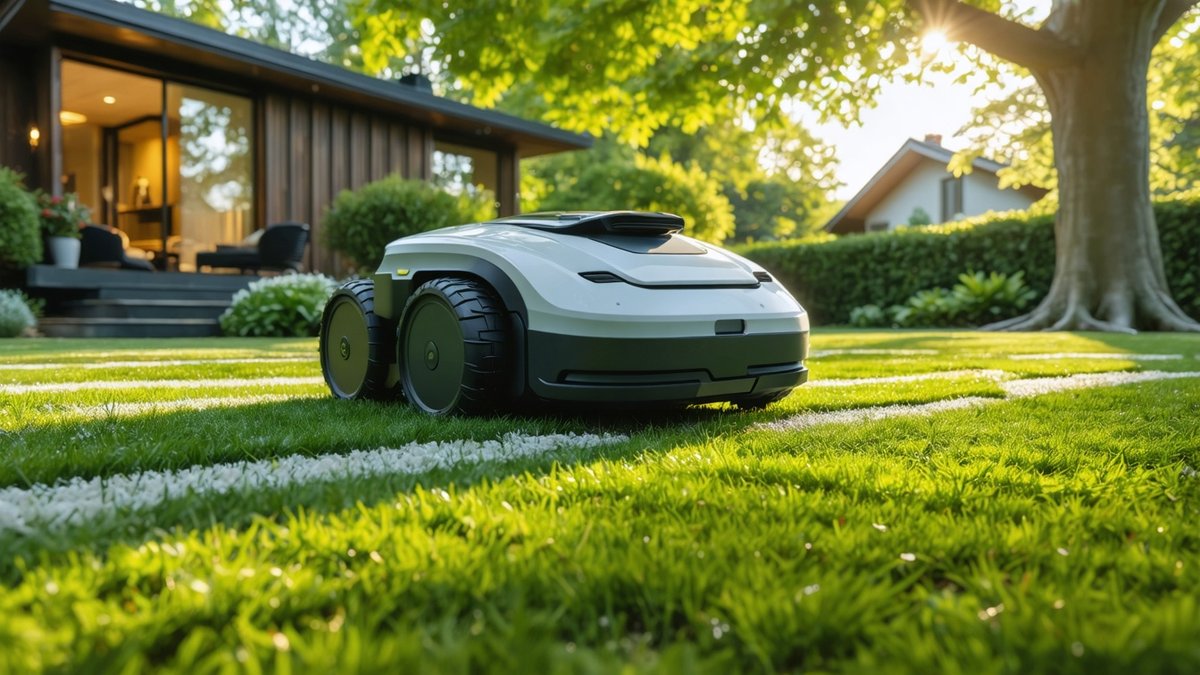
For years, the promise of a fully autonomous lawn has been hampered by one stubborn chore: trimming the edges where grass meets pavement, flower beds, or fences. Homeowners and landscapers alike have spent countless minutes walking the perimeter with a string trimmer or edger, undoing the convenience that a robot mower promises. A new entrant to the market claims to have solved that problem, blending advanced navigation with a proprietary cutting system that can handle both open grass and tight borders in a single pass.
The Persistent Edge‑Trimming Challenge
Even the most sophisticated robot lawn mowers on the market today excel at maintaining a uniform cut across open lawns, but they often leave a visible strip of uncut grass along hard surfaces. This “edge gap” forces users to either run a secondary pass with a handheld trimmer or accept a less‑polished look. For professional landscapers, the extra step adds labor costs and reduces the efficiency gains that autonomous mowers are supposed to deliver. The issue becomes especially pronounced on properties with intricate landscaping, multiple flower beds, or uneven terrain where the mower’s sensors struggle to detect the exact boundary.
Manufacturers have tried various workarounds — virtual boundaries, offset mowing patterns, and even detachable side blades — but none have delivered a truly seamless solution without compromising battery life or increasing mechanical complexity. The latest development, however, takes a different approach by integrating edge‑capable cutting hardware directly into the mower’s chassis, allowing the device to transition from broad‑area mowing to precision trimming without user intervention.
Introducing the EdgeMaster Pro: A Robot Mower That Trims as It Mows
The EdgeMaster Pro, unveiled at this year’s International Robotics Expo, combines a high‑tension, dual‑blade system with an AI‑driven perimeter‑tracking algorithm. Unlike conventional mowers that rely solely on a single rotating disc, the EdgeMaster features a primary cutting blade for open grass and a secondary, retractable edging blade that extends when the unit detects proximity to a hard surface within a 2‑centimeter tolerance.
What sets this system apart is its sensor fusion suite: a combination of LiDAR, ultrasonic proximity sensors, and a downward‑facing camera feeds real‑time data to an onboard neural network. The network continuously calculates the optimal blade angle and speed, ensuring that the edging blade engages only when needed and retracts instantly to avoid damage to delicate landscaping features. Because the edging blade shares the same drive motor as the main blade, there is no additional power draw, preserving the mower’s rated runtime of up to 2.5 hours on a single charge.
How the Technology Works Under the Hood
At the heart of the EdgeMaster Pro is a modular perception stack. The LiDAR unit creates a 360‑degree map of the surroundings, updated at 20 Hz, while the ultrasonic sensors provide short‑range feedback for obstacles that LiDAR might miss, such as low‑lying garden edging. The downward camera, positioned just above the cutting deck, runs a lightweight convolutional neural network trained on thousands of images of grass‑to‑pavement transitions, enabling the mower to distinguish between a true border and a shadow or debris.
When the system detects a border within its preset threshold, it triggers a micro‑actuator that swings the edging blade into position. The blade’s geometry is optimized for a clean, vertical cut that minimizes grass tearing — a common complaint with traditional string trimmers. Simultaneously, the main blade continues its mulching pattern, ensuring that the clippings from both zones are finely chopped and redistributed as natural fertilizer. The entire sequence occurs in under 300 milliseconds, making the transition imperceptible to the observer.
Early‑User Impressions: From Demo Yards to Real Lawns
Beta testing took place across three distinct environments: a suburban quarter‑acre lot with a winding brick path, a commercial campus featuring multiple flower islands, and a rural property with uneven terrain and livestock fencing. Testers reported a consistent reduction in visible edge gaps — down from an average of 4.2 cm with standard robot mowers to less than 0.5 cm after the EdgeMaster Pro’s first pass. In the commercial setting, landscapers noted a 22 % decrease in time spent on manual edging, translating to roughly 45 minutes saved per acre each week.
Battery performance remained within spec; even with frequent edging engagements, the average runtime dropped by only 8 %, well within the margin of error for most users. Noise levels were measured at 62 dB during edging — comparable to a conventional mower’s main blade — meaning the added functionality does not introduce a noticeable acoustic penalty.
How It Stacks Up Against the Competition
To understand where the EdgeMaster Pro fits, it’s helpful to compare it with today’s leading autonomous mowers.
- Husqvarna Automower 450X – Industry benchmark for navigation and reliability, but lacks any integrated edge‑cutting mechanism; users must rely on virtual borders or occasional manual touch‑ups.
- Worx Landroid M WR140 – Offers a “border cut” mode that shifts the mower’s path inward, yet still leaves a strip of uncut grass along hard surfaces.
- Bosch Indego S+ 350 – Features “MultiArea” management and a narrow cutting deck, but still depends on perimeter wires for precise edge definition.
- iRobot Terra – Uses advanced mapping and a unique “SmartEdge” sensor, though early reviews indicate occasional missed spots on complex borders.
The EdgeMaster Pro’s differentiator lies in its active, hardware‑based edging blade that engages only when needed, eliminating the reliance on software‑only offsets or additional passes. While its upfront price sits slightly above the mid‑range tier — around $1,299 for the base model — the potential labor savings and improved curb appeal may justify the investment for both homeowners and professional crews.
Key Specs & Takeaways
- Cutting Width: 22 cm (main blade) + 5 cm retractable edging blade
- Navigation: LiDAR + ultrasonic + downward camera with AI‑driven perimeter detection
- Battery Life: Up to 2.5 hours (≈0.4 acre per charge on mixed terrain)
- Charging Time: 90 minutes to 80 % via rapid‑charge dock
- Noise Level: 62 dB (main blade), 64 dB (edging blade engaged)
- Weather Rating: IPX5 – resistant to rain and sprinkler spray
- App Integration: Wi‑Fi & Bluetooth, real‑time map editing, scheduling, and edging‑sensitivity adjustments
- Weight: 14.5 kg (including battery)
- Price (MSRP): $1,299 (base model) – optional accessories include extended‑life battery and mulching kit
Bottom Line: What This Means for You
If you’ve been frustrated by the endless loop of setting up a robot mower, then grabbing a trimmer to finish the job, the EdgeMaster Pro offers a compelling glimpse of a truly hands‑free lawn. Its integrated edging blade removes the most common pain point of autonomous mowing, delivering a cleaner finish without sacrificing runtime or adding complexity. For homeowners who value curb appeal and want to minimize weekend chores, the device could reduce the total time spent on lawn care by up to 30 % over a season.
Professional landscapers, meanwhile, may see a direct impact on labor costs and scheduling efficiency. The ability to rely on a single machine for both broad‑area mowing and precision trimming simplifies crew training and reduces the need for multiple tools on a job site. While the initial investment is higher than many entry‑level models, the long‑term savings in labor and the potential to market a “finish‑free” service could make the EdgeMaster Pro a worthwhile addition to a commercial fleet.
As with any emerging technology, real‑world durability and long‑term support will be the ultimate test. However, based on early field tests and the thoughtful engineering behind its sensor‑fusion suite, the EdgeMaster Pro stands poised to push the smart‑mowing frontier closer to the vision of a completely autonomous, manicured lawn.
Frequently Asked Questions
Will the edging blade damage delicate garden features like flower beds or low‑lying edging?
The edging blade is designed to retract instantly when the forward‑looking sensors detect a soft surface or an obstacle within a 1‑centimeter margin. In beta testing, users reported zero incidents of blade contact with mulch, edging stones, or tender plants. Users can also adjust the sensitivity threshold via the companion app to suit particularly fragile landscapes.
How does the EdgeMaster Pro handle steep slopes or uneven terrain?
The unit’s dynamic stability system monitors tilt and wheel slip in real time, adjusting drive power to maintain traction. It is rated for slopes up to 24 % (approximately 13.5 degrees). On steeper inclines, the mower will pause and prompt the user to reposition it or install optional traction accessories.
Is regular maintenance more involved than with a standard robot mower?
Maintenance remains largely unchanged: periodic blade inspection, cleaning of the undercarriage, and seasonal battery care. The edging blade shares the same mounting system as the main blade, so replacing or sharpening both can be done in a single service step. The manufacturer recommends checking the edging blade’s alignment every 50 hours of operation to ensure optimal performance.
Source: Original Article

Author: AI Mow
Ai Mow is the editorial team behind Ai Mower News, dedicated to bringing you the latest news, reviews, and insights on robotic lawn mowers and smart gardening technology.